Why stainless steel at all
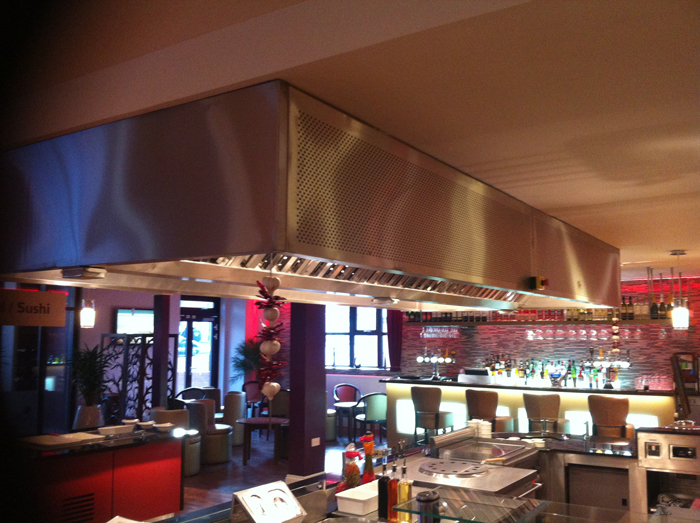
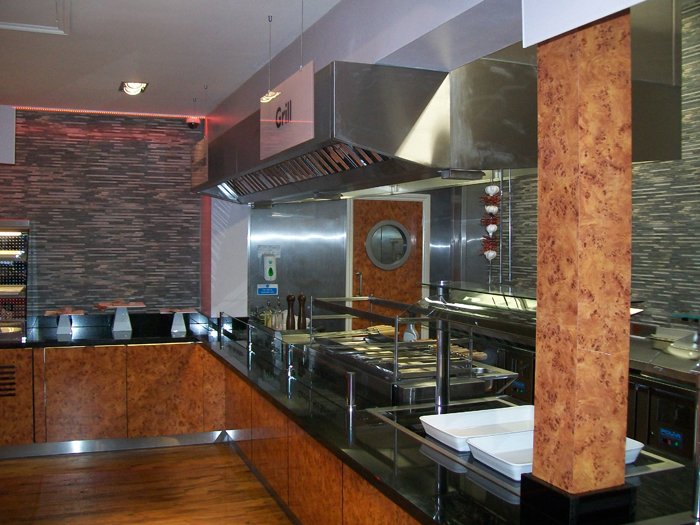
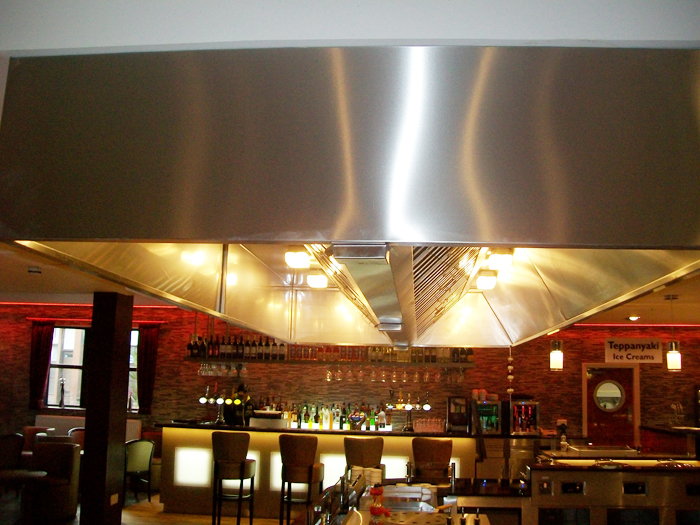
Kitchen extraction canopies live in a hostile environment: heat, steam, grease and frequent cleaning. HSE guidance in CAIS10 says canopies and ductwork need to be made from non-combustible material and built so they discourage accumulations of dirt, grease and condensation. Stainless steel is non-combustible, smooth, and withstands cleaning chemicals, which is why it is the standard material for commercial canopies.
What 304 means
Stainless steel grades differ in composition. 304 (also written En.1.4301) is the most widely used general-purpose grade in catering equipment. It resists everyday corrosion, polishes well and is easy to fabricate and weld. For most commercial kitchens inland, it is the sensible, durable choice.
What 20 gauge (1mm) means
Gauge describes the thickness of the sheet. Our canopies are 20 gauge, which is 1mm. A canopy has to be stiff as well as thin enough to fabricate economically, so thickness is combined with bracing, which we use to prevent distortion under heat and over time.
Welded and polished joints
How the joints are made matters as much as the grade. Welded and polished joints leave no crevices where grease and bacteria collect, and they look cleaner. Sealed or riveted joints can open up with heat cycles. On our canopies, all joints are welded and polished.
When to ask about other grades
Some environments are harder on stainless steel, for example coastal sites with salt-laden air or kitchens where strong chemicals are used. In such cases another grade may be worth discussing with the designer. Tell us about your site at survey so the material is chosen for the conditions rather than assumed.
Questions to ask any canopy manufacturer about materials
- Which grade and gauge of stainless steel is used for the canopy, and for the filter housing?
- Are the joints welded and polished, or sealed or riveted?
- How is the canopy braced to stop it distorting?
- What is the finish, and how does it affect cleaning?
- Does the supplier have experience of kitchens like yours, for example coastal or heavily used sites?
A manufacturer who fabricates at its own works, as we do, can answer these directly. Ask us about extraction canopies for your site.
Finish and cleaning
A smooth satin finish is easier to clean and more resistant to grease staining. Clean the canopy interior and drip trays regularly, and keep the baffle filters in good condition; see baffle filters and kitchen extraction cleaning. The same material is used for stainless steel wall cladding behind cooking ranges.
Frequently asked questions
Is 304 stainless steel food safe?
304 is the standard general-purpose stainless steel used throughout catering equipment, and is easy to clean.
What does 20 gauge mean?
It is a sheet thickness of about 1mm.
Will stainless steel rust?
Stainless steel resists corrosion but is not immune, particularly in salty or chemical-heavy environments. Ask us if your site is unusual.
Why are joints welded?
Welded and polished joints avoid crevices that trap grease and are stronger than riveted or sealed joints.
Can you supply canopies in other materials?
Tell us what you need. We design bespoke canopies to suit the site.