Safe, compliant, comfortable commercial kitchens — extract design, gas interlocking, ductwork and stainless steel cladding, all under one roof.
A commercial kitchen ventilation system supplies clean, cool air, removes heat, grease-laden air and combustion gases at the cooking source, and expels them to a safe exterior location. It typically combines an extraction canopy, baffle filtration, ductwork to DW/172 and a make-up air system, with a BS6173 gas interlock where gas appliances are used. Cool Stream designs, manufactures and installs them across the UK.
In order to provide a safe and comfortable working environment, commercial kitchen extract systems need to address a number of key areas. For the comfort of those working in the kitchen, ventilation must ensure sufficient, clean, cool air. The supply of air must also be sufficient for complete combustion of gas-burning equipment.
The gases generated by the combustion process need to be effectively removed from the working environment and expelled to a safe exterior location — as close to the generating source as possible. Any system should be kept effectively clean from grease and fat residues to prevent a possible fire hazard or reduce the effectiveness of the system.
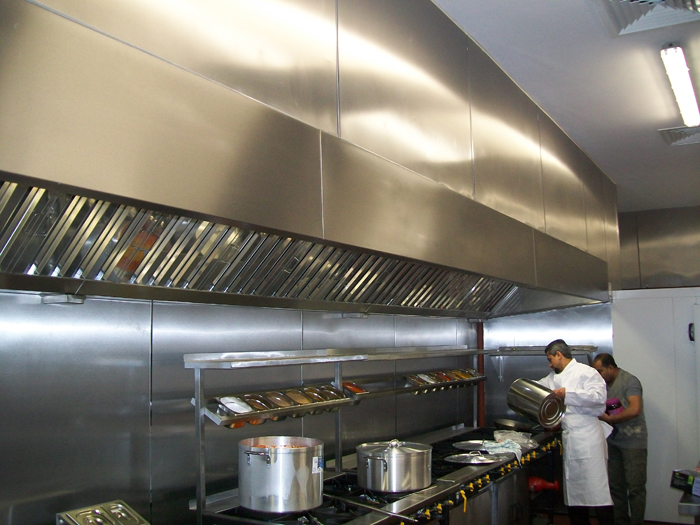
Full design service tailored to your cooking line and floor plan.
Wall, island and bespoke canopies fabricated to order.
Baffle filtration systems that control grease and odour.
Ductwork manufactured to the HVCA DW/172 specification.
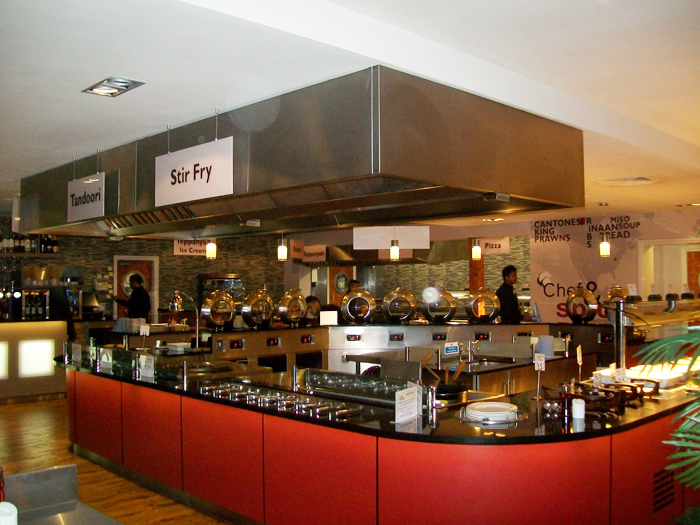
We meet the client or architect to discuss requirements and site-visit the premises, followed by proposed scheme drawings, including any filtration systems required and odour control. We attend design meetings and liaise with the architect, structural engineers, other services, the developer and the Environmental Health Officer — ultimately providing a clear quotation for installation.
All new installations, and some existing installations where modifications or new equipment is being fitted, must have a gas interlocking system to comply with BS6173. The interlock prevents gas being turned on until the ventilation system is fully operational, using an air pressure sensor or current monitoring to detect the canopy is working with sufficient air flow. Only then does the normally-closed gas solenoid valve open. If airflow later falls below the required level, or ventilation is switched off, the gas supply is automatically cut.
Cool Stream Ventilation supplies and installs commercial gas kitchen systems that fully comply with BS6173, with all gas components and catering equipment approved by a commercially registered Gas Safe Register (formerly Corgi) installation engineer.
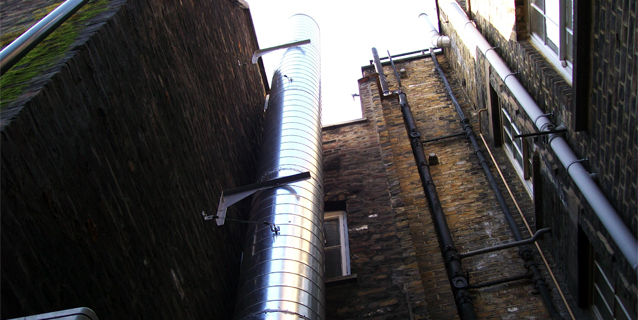
We install kitchen extract ductwork systems to suit all clients' requirements. Ductwork can be manufactured from mild steel, fully welded with angle iron flanges, or galvanised with mezz flanges — all manufactured to the HVCA-recommended DW/172 specification. We also provide suitable access doors for system cleaning, and fire-rated ducting where required.
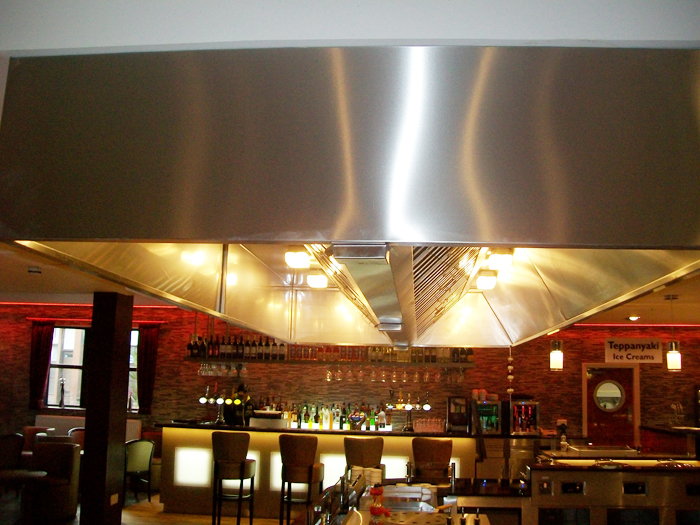
Stainless steel wall cladding is ideal for areas directly subject to high temperatures — for example behind cooking ranges and under extract canopies. Easy to clean and fully EHO compliant, our stainless steel sheeting can be tailored to suit most cooking areas. We supply and install cladding beneath kitchen extraction canopies, or anywhere else it might be required.
A commercial kitchen extraction system does four jobs at once. It captures heat, steam, grease and cooking fumes at the appliance, carries them out of the building through ductwork, replaces the air it removes with fresh make-up air, and, where gas appliances are fitted, proves to the gas supply that it is working before gas is allowed to flow. If any one of those jobs is missed, the kitchen becomes hot, greasy, smelly or unsafe, however good the other parts are.
The main components, in the order the air meets them, are:
Designing these as one balanced system, rather than buying a canopy, a fan and some duct separately, is what keeps a kitchen comfortable and compliant. It is also the reason the same team should survey, design, build and commission it.
There is no single "kitchen extraction law". Instead a handful of regulations and industry documents apply together, and an installer should be able to tell you which ones matter for your premises. The Health and Safety Executive's catering information sheet CAIS10: Ventilation in catering kitchens is the clearest starting point.
| Requirement | What it covers | Why it matters to you |
|---|---|---|
| Workplace (Health, Safety and Welfare) Regulations 1992 | Employers must provide effective and suitable ventilation in every enclosed workplace, including kitchens | Heat, fumes and vapour must be removed so staff can work safely and comfortably |
| Gas Safety (Installation and Use) Regulations 1998 | Gas appliances in catering premises; where extraction serves as the flue, an interlock links airflow to the gas supply | Gas work must be done by a Gas Safe engineer, and make-up air must be adequate for combustion |
| BS 6173 | Installation of gas-fired catering appliances, including interlocking | The standard we install gas interlocks to |
| DW/172 (BESA) | Specification for kitchen ventilation systems and ductwork | The standard our extract ductwork is manufactured to |
| TR/19 (BESA) | Internal cleanliness of ventilation systems | Guides how clean the ductwork must be kept to limit fire risk |
| Planning conditions and environmental health | Odour, noise and discharge height, set locally | Often decide the final design, particularly near homes |
Standards are revised from time to time, so always check the current edition. If you are unsure which apply to a particular kitchen, tell us what you cook, what fuel you use and where the building is, and we will advise as part of the survey.
HSE guidance says the design should take account of the cooking load, the amount of cooking equipment, the layout and shape of the kitchen, the number of staff and the need for easy cleaning and maintenance. In practice that means we ask for:
From that we produce scheme drawings that show the canopy, filtration, duct route, fan position and make-up air, so you, your architect and the local Environmental Health Officer can review the design before anything is made. HSE advises that the extraction rate is best calculated from the information supplied with the appliances, together with the air change rates needed for kitchens. We cover the numbers in our guide to extraction rates and air changes.
Canopies. The canopy has to be big enough, and close enough to the cooking surface, to capture the plume. HSE says there should be a canopy hood for every appliance or other source that generates fumes and heat. We manufacture wall-mounted, island, L-shaped, box and dishwasher canopies in 304 stainless steel, and can make bespoke sizes. Our guide to choosing an extraction canopy explains the differences.
Filters. Baffle filters remove grease before it reaches the duct. They need to be easy to take out and clean, and replaced when damaged.
Ductwork. HSE says canopies and ductwork need to be made from non-combustible material, built so they discourage grease build-up, and fitted with suitable access for regular cleaning. That is why our ductwork is welded or flanged to DW/172 and includes access doors.
Discharge. HSE notes that high-level discharge is often needed to prevent nuisance to neighbours, and that rain caps and downward-directed discharge should be avoided because they impede the plume or let fumes re-enter the building.
Two problems turn up again and again when we are asked to look at a kitchen that "never works properly".
No make-up air. An extract fan can only remove as much air as can get back in. If the kitchen is sealed or starved, the canopy spills fumes, doors slam or pull, and gas appliances can burn badly. HSE says make-up air should be fresh and unadulterated from outside, not drawn from dirty areas such as waste stores or smoking areas, and should not impair the flues serving gas appliances. Read more in what make-up air is and how to supply it.
No working interlock. Where gas appliances rely on the extraction, the gas supply should be interlocked with the airflow. A missing, bypassed or failed interlock is one of the most serious defects in a commercial kitchen. We explain how it works in BS6173 gas interlock systems explained.
If the kitchen is new, or the use of the unit is changing, the local planning authority may attach conditions about odour, noise and the position of the flue. Councils usually look for evidence that the system will control odour (often through filtration stages and a suitably high discharge point) and that fan noise will not disturb neighbours. We design these requirements in from the start and liaise with architects, structural engineers and the Environmental Health Officer. For the planning side, see our guide to planning permission for commercial kitchen extraction.
We cover the whole of the UK; see where we work.
A system that was right on commissioning day can drift: filters clog, belts slip, grease builds up in the duct and a fan motor gets noisy. HSE says mechanical ventilation should be maintained in efficient working order in line with the manufacturer's or installer's instructions. In practice that means a routine for filter cleaning, regular checks of fans and the interlock, and specialist cleaning of the ductwork at a frequency suited to how heavily you cook. Our guide to extract system cleaning and TR/19 explains the options, and our planned maintenance covers the plant we look after. Spot the early warning signs in 5 signs your kitchen extraction needs attention.
We are happy to answer all ten before you commit. Call 07759 696007 or WhatsApp us.
Kitchen extract design and installation, extract canopies, filtration systems and ductwork, balanced by a make-up air system, with BS6173 gas interlocking where gas appliances are fitted.
Yes. We can design commercial kitchen ventilation for either back or front of house and tailor it to individual operational requirements, in wall or island types.
Yes. Gas interlocking is installed to BS6173 by Gas Safe registered engineers, and all kitchen extract ductwork is manufactured to the HVCA DW/172 specification.
Yes. We survey, design, manufacture, install and commission for customers across the UK. Call 07759 696007 or WhatsApp us to discuss your site.
The main ones are the Workplace (Health, Safety and Welfare) Regulations 1992 (effective ventilation), the Gas Safety (Installation and Use) Regulations 1998 (gas appliances and interlocking), BS 6173 for gas catering appliances, DW/172 for ductwork, TR/19 for cleanliness, plus local planning and environmental health conditions. HSE publishes a catering information sheet, CAIS10, as the starting point.
DW/172 is the BESA (formerly HVCA) specification for kitchen ventilation systems. Our extract ductwork is manufactured to it.
Almost always. Extracted air has to be replaced. HSE advises that make-up air should be fresh air from outside, not drawn from dirty areas, and that it should not interfere with the flues serving gas appliances.
Where extraction serves as the flue for gas appliances, an interlock connecting the airflow to the gas supply is required. New installations, and some modified ones, must comply with BS 6173. We will tell you what applies to your kitchen at survey.
HSE says high-level discharge is often needed to prevent nuisance to neighbours, and that rain caps and downward-directed discharge should be avoided. The exact position depends on the building and any planning conditions.
It depends on the size of the kitchen, the duct route and whether the canopy is standard or bespoke. We give a programme with the quotation after the survey.
Often yes, using a vertical duct through the building to a high-level discharge, but it needs to be designed carefully for fire, noise and access. We assess it at survey.
Yes. We design kitchen extraction for restaurants, takeaways, hotels, schools, canteens and other commercial kitchens, front or back of house.
Yes. Common causes are missing make-up air, blocked filters or ductwork, undersized fans or a canopy that no longer matches the appliances beneath it. We survey and recommend the most cost-effective fix.
Call or WhatsApp 07759 696007 or email info@coolstreamventilation.co.uk with your location and what you cook. We will arrange a survey and send scheme drawings and a quotation.
Wherever your site is, we survey, design, manufacture and install. Find your nearest area, or call 07759 696007.