Start with your cooking line, not the canopy
The right extraction canopy is decided by your kitchen layout and equipment, not the other way around. Before specifying anything, map out where your heat sources sit, how much clearance you have, and whether your cooking line is against a wall or free-standing.
The main canopy types
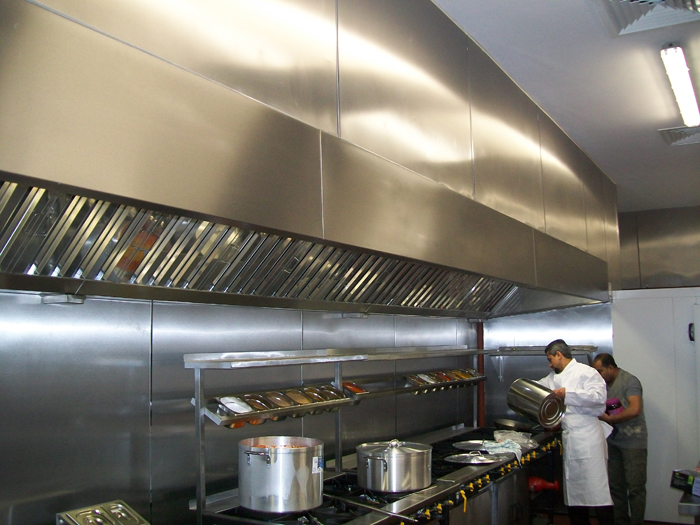
- Wall-mounted / tapered canopies — the most common choice, fitted directly above a cooking line that runs along a wall.
- Island canopies — for cooking stations, such as chargrills, positioned away from any wall, extracting from above on all sides.
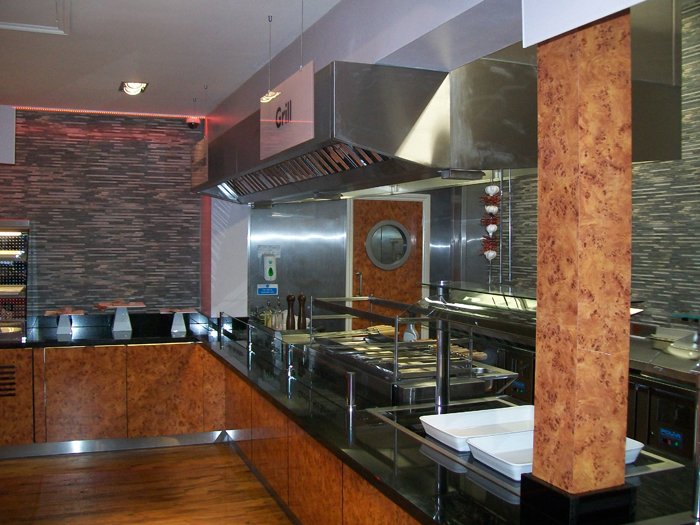
- Theatre canopies — designed to sit over an open, customer-facing cooking display, drawing in supply air through front perforations so diners can watch the cooking without the extraction being obtrusive.
- L-shaped and box canopies — for awkward corners or kitchens where equipment doesn't sit in a straight run.
- Dishwasher canopies — purpose-built to handle the steam and condensation load from commercial dishwashers, rather than grease and combustion gases.
Getting the size right
Standard canopies are typically 1100mm deep, with 1300mm and 1500mm depth options available for larger equipment. Lengths are generally supplied in bands — from under 1.2 metres for a single-station takeaway kitchen, up to 6 metres for large-scale catering — but bespoke sizing is always available where standard bands don't fit your space.
Material and finish matter
Look for 304 (En.1.4301) grade stainless steel, ideally 20 gauge (1mm), with all joints welded and polished rather than just sealed. A canopy that's braced properly won't distort under heat, and a smooth satin finish is both easier to clean and more resistant to grease staining over time.
Don't forget the extras
Baffle filters, integral lighting, drip trays, anti-drip moulding and a full-length filter housing with removable drawers all make day-to-day cleaning and compliance easier. If your site has awkward access or unusual equipment, ask whether fire suppression, anti-bacterial coating or a fire-rated ductwork option should be built in from the start.
Capture, not just size
A canopy works by capturing the plume of hot, greasy air rising from the appliances. CAIS10 says the canopy hood must be a suitable size, have enough extraction to minimise fume spillage, be as close as possible to the source taking the work into account, and that there should be a canopy hood for every appliance and other source generating fumes and heat. The airflow into the canopy should be uniform and constant.
Questions to ask before you order
- What is the canopy's design airflow, and what is it based on?
- Is it big enough for the appliances beneath it, including any that will be added later?
- What grade and gauge of stainless steel is it made from?
- Are grease filters easy to remove for cleaning?
- Does the price include the ductwork, fan, make-up air and interlock, or only the box?
- Who installs it and who commissions it?
Canopy as part of a system
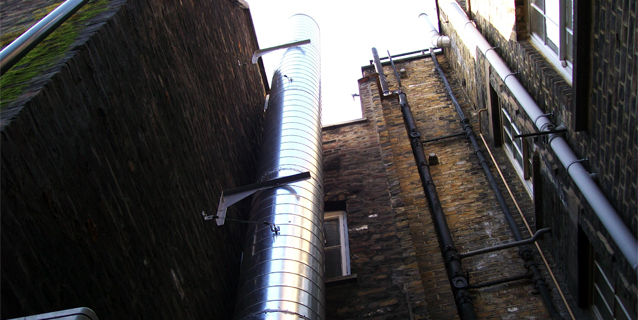
A canopy is only one part of the extraction system: it needs ductwork built to DW/172, baffle filters, make-up air and, with gas, an interlock. See our extraction canopy service and the cost drivers guide.
Questions about existing canopies
Reusing a canopy can make sense when the new appliances are similar to the old ones, the stainless steel is sound and clean, the filters are intact and the extract and make-up air are adequate. It makes less sense when the cooking line has grown, the canopy is dented or corroded, or the system has never been commissioned. A survey will tell you which applies; ask us to survey your kitchen.
Canopies and the planning officer
A canopy is rarely judged alone: the council or Environmental Health Officer will usually want to see how the whole system captures, filters and discharges. Choose the canopy together with the filtration and the discharge, and see our guide to planning permission for kitchen extraction.
Frequently asked questions
Can I use a second-hand canopy?
Only after checking it suits the new appliances, is clean, undamaged and has suitable filters, and that the extract and make-up air systems match.
What is a theatre canopy?
A canopy designed over an open cooking display, drawing in air through perforations so diners can watch the cooking.
Do I need a canopy over a dishwasher?
Dishwasher canopies handle steam and heat. They are commonly fitted to reduce humidity and improve comfort.
What size canopy do I need?
It depends on the appliances and layout. We recommend one after a survey.