What the F-Gas Regulation actually requires
The F-Gas Regulation places a legal liability on anyone operating air conditioning or refrigeration equipment to ensure refrigerant does not leak, and is recovered properly during servicing and replacement of systems, in order to limit refrigerant emissions to the atmosphere.
In practice, that means your air conditioning plant needs to be professionally monitored and maintained by engineers qualified to current industry standards — not just serviced when something breaks.
The 5% threshold
Best-available techniques should keep the relative loss of refrigerant below a maximum of 5%. Any used refrigerant that isn't intended for re-use has to be treated as waste and disposed of safely — it can't simply be vented or discarded.
Leak detection starts at installation
Good practice doesn't begin when a fault appears — it starts on day one. Every installation should be properly tested in accordance with BS EN378, with pressure testing carried out to confirm the system is genuinely leak-tight before it's ever switched on for the client.
Beyond compliance: protecting your business
Treating F-Gas compliance as a box-ticking exercise misses the point. A full system analysis — not just a leak repair — protects a business against equipment breakdowns, regulatory penalties and rising energy costs, because a system that's leaking refrigerant is also a system working harder than it should be.
What about older R22 systems?
Where a system is beyond economical repair, or still runs on the now-phased-out R22 refrigerant, replacement is usually more cost-effective than continued patching. A competitively priced replacement, installed with minimum disruption, also brings the added benefit of modern, more efficient refrigerants like R410A.
The rules in practice
Under GOV.UK's F-gas guidance, if you operate equipment containing F-gas you must check it for leaks at intervals set by the amount of gas it holds, using a suitably certified person. The intervals in GOV.UK's leak-check guidance are: every 12 months for equipment containing at least 5 tonnes of CO2 equivalent, every 6 months from 50 tonnes and every 3 months from 500 tonnes (or automatic leak detection), and the interval is doubled where an automatic leak detection system is fitted. Leaks must be repaired as soon as possible, and the equipment rechecked within a month. For common R410A systems, GOV.UK gives approximate equivalents of 2.4 kg, 24 kg and 240 kg of refrigerant. These figures are correct as of this article; always check the GOV.UK F-gas collection for the latest rules.
A short operator's checklist
- Find the refrigerant type and charge on each system's data plate.
- Work out the CO2 equivalent to establish your leak-check interval.
- Appoint a suitably certified contractor.
- Keep records of checks, leaks, repairs and refrigerant added or recovered.
- Repair leaks promptly and arrange the follow-up check.
- Plan replacement of old R22 systems.
Where Cool Stream fits
We test installations to BS EN 378 and apply measures in line with best available techniques to keep relative refrigerant loss low. Our planned maintenance and air conditioning pages explain how we help, and our restaurant air conditioning guide covers the practical side for restaurants.
What about restaurants and kitchens?
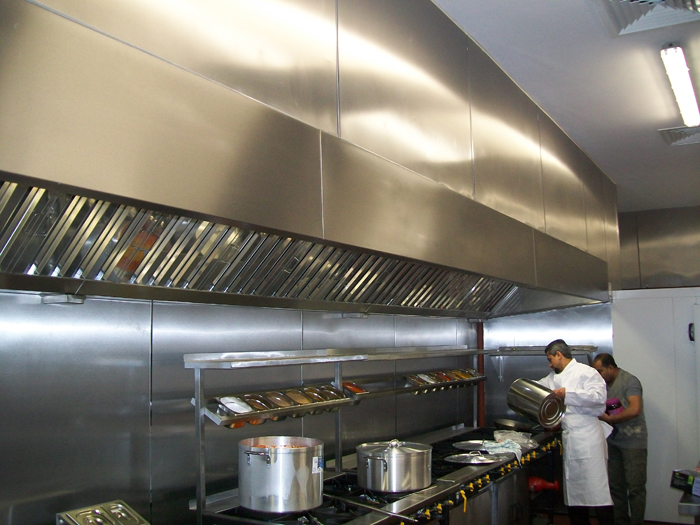
Commercial kitchens use air conditioning in dining areas and sometimes in the kitchen itself, and cold rooms and refrigeration also use F-gas. As the operator you are responsible for each system, so keep a list of every F-gas system on site, with its refrigerant type and charge, and agree a leak-check schedule with a certified contractor. For restaurants, see our air conditioning guide.
Frequently asked questions
What are the F-gas leak check intervals?
Every 12 months for at least 5 tonnes CO2 equivalent, every 6 months from 50 tonnes and every 3 months from 500 tonnes, doubled where leak detection is fitted. Check current GOV.UK guidance.
Who is responsible for leak checks?
The operator of the equipment, usually the business using it.
What happens if a leak is found?
It must be repaired as soon as possible and the equipment rechecked within a month.
Can I still service R22 air conditioning?
R22 can no longer be used to service existing equipment, so leaking R22 systems are usually replaced.
Do I need to keep records?
Yes, records of checks, leaks, repairs and refrigerant movements should be kept; see GOV.UK guidance.