Ductwork designed and manufactured to the HVCA DW/172 specification, with access doors for cleaning and fire-rated options where required.
DW/172 is the HVCA (now BESA) specification for the construction of kitchen extract ductwork. Cool Stream manufactures all of its kitchen ductwork to DW/172, in fully welded mild steel or galvanised steel, with access doors for cleaning and fire-rated options where required.
We install kitchen extract ductwork systems to suit all client requirements. Ductwork can be manufactured from mild steel, fully welded with angle iron flanges, or galvanised with mezz flanges. All of our ductwork is manufactured to the HVCA recommended specification DW/172.
We also provide suitable access doors for system cleaning and fire-rated ducting if required. Gases from cooking should be removed as close to the generating source as possible and expelled to a safe exterior location, and any system should be kept clear of grease and fat residues to prevent a possible fire hazard.
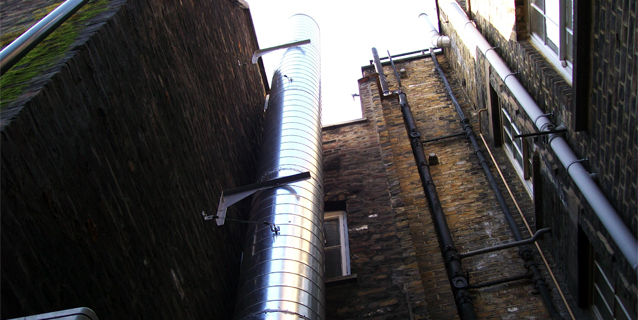
DW/172 is the BESA (formerly HVCA) specification for kitchen ventilation systems. It covers how ductwork should be made, jointed, supported and fitted with access, so that it stays sound and can be cleaned. We manufacture our kitchen extract ductwork to it, in mild steel fully welded with angle iron flanges, or galvanised with mezz flanges. Always check the current edition of the standard.
HSE says canopies and ductwork need to be non-combustible, made so they discourage grease build-up, and fitted with suitable access for regular cleaning. That drives a handful of design decisions: avoiding horizontal runs that trap grease, minimising bends, placing access doors where they can actually be reached, and using fire-rated ducting where the route passes through fire compartments. See CAIS10.
HSE advises that high-level discharge is often needed to avoid nuisance to neighbours, that rain caps and other devices that impede upward velocity should be avoided, and that downward-directed discharge should never be used. Attenuation is designed in where planning conditions limit noise. These details are often the difference between a quick sign-off and a planning problem. Read more in our planning guide.
If you inherit a kitchen, check the ductwork before you trust it. Look for access doors (and whether they can be opened), visible grease at joints, sagging or dented runs, unsealed joints, rain caps on the discharge and any horizontal sections that hold grease. HSE advises that where design information is absent for an existing installation the system should be recommissioned and a performance report produced; we can do that as part of a survey, and recommend whether to repair, modify or replace.
Grease in a duct is a fire load. Access doors make cleaning possible, and BESA's TR/19 guidance covers internal cleanliness. How often you need a specialist clean depends on what and how much you cook; we explain the options in extraction cleaning and TR/19. Ductwork is one element of our complete kitchen extraction service.
DW/172 is the HVCA recommended specification for kitchen ventilation ductwork. All of our kitchen extract ductwork is manufactured to it.
Yes. We can provide fire-rated ducting where it is required.
Yes. We provide suitable access doors so the system can be cleaned and kept clear of grease and fat residues.
Yes, after a survey to confirm the canopy, fan and make-up air match the duct.
Where the route passes through fire compartments, it is usually required. We advise at survey.
Through access doors, using specialist cleaning following guidance such as TR/19. We install the access doors.
HSE advises high-level discharge is often needed to avoid nuisance and re-entry of fumes.
Mild steel fully welded or galvanised with mezz flanges are both used; we advise based on the route and use.
Wherever your site is, we survey, design, manufacture and install. Find your nearest area, or call 07759 696007.