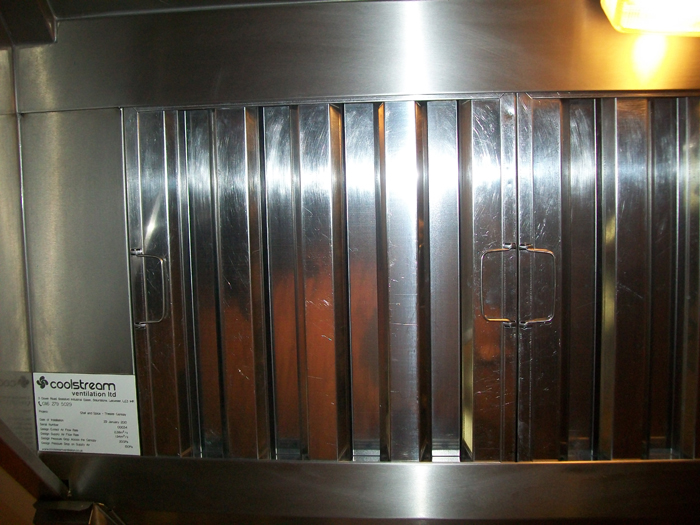

What a fan has to do
An extract fan moves a volume of air against resistance. The volume comes from the design (how much air must be removed). The resistance comes from everything the air passes through: grease filters, bends in the ductwork, silencers, grilles and the discharge. A fan is chosen so that it delivers the design airflow at the system's resistance, with some margin, while meeting noise limits.
Axial fans
Axial fans move air straight through, like a propeller in a tube. They are compact and good for moving large volumes against low resistance, so they are common for wall fans, simple extract and short duct runs. They are less suited to long or complex duct runs with filters.
Centrifugal fans
Centrifugal fans draw air in and throw it outward through an impeller. They can generate higher pressure, so they cope better with ductwork, filtration and bends. They are widely used for ducted ventilation and kitchen extract.
Inline, roof-mounted and wall-mounted
| Arrangement | Typical use | Notes |
|---|---|---|
| Inline duct fan | Within a duct run, in a ceiling void or plant room | Saves space; needs access for maintenance |
| Roof-mounted | Discharges at roof level | Helps with high-level discharge |
| Wall-mounted | Simple, short extract | Lower cost, limited to small duties |
| Plant room fan | Larger systems and air handling units | Higher capacity, serviced from a plant space |
Kitchen extract has special requirements
Kitchen extract air is hot, humid and grease-laden, so the fan has to be suitable for it and positioned so it can be accessed for cleaning and maintenance. HSE says mechanical ventilation should be maintained in efficient working order in line with the manufacturer's or installer's instructions (CAIS10), and high-level discharge is often needed to prevent nuisance to neighbours. The fan, ductwork and canopy must be matched; see DW/172 ductwork.
Common fan problems and what they usually mean
| Symptom | Common causes |
|---|---|
| Less airflow than expected | Blocked filters, greasy ductwork, wrong fan for the system resistance, missing make-up air |
| Noise or vibration | Worn bearings, loose or unbalanced impeller, loose ductwork or supports |
| Smell of burning | Slipping belt, overloaded motor, grease build-up |
| Fan runs but nothing moves | Belt failure, reversed rotation, closed damper |
Any of these on a kitchen system is worth acting on quickly, since a failing fan can affect the gas interlock as well as comfort. See planned maintenance and 5 signs your kitchen extraction needs attention.
Noise, controls and efficiency
Noise comes from the fan and from air moving through grilles and ducts, so silencers and sensible duct velocities matter. Speed controls, timers and sensors stop fans running harder than needed, which saves energy. Always ask for the fan's duty at the real system resistance, not just a catalogue maximum.
We design ventilation from a small fan in the wall to large ducted fresh-air units; see commercial ventilation. For the complete kitchen system, see kitchen extraction systems.
Frequently asked questions
What is the difference between axial and centrifugal fans?
Axial fans move air straight through and suit low resistance. Centrifugal fans generate more pressure and suit ducted systems.
Can I use a normal fan for kitchen extract?
Kitchen extract is hot and grease-laden, so the fan must be suitable and accessible for cleaning. The designer specifies it.
How do I know what fan size I need?
From the design airflow and the system resistance. We calculate it at design stage.
Do fans need maintenance?
Yes. Motors, belts, bearings and impellers need regular checks.