Two ways to take fumes out
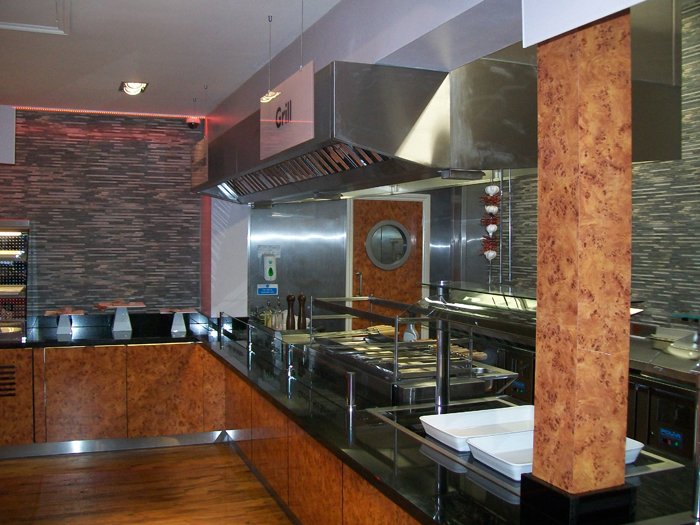
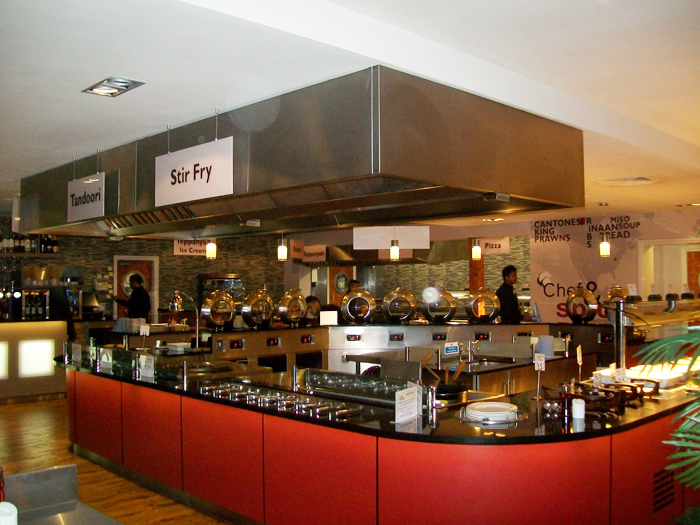
Most commercial kitchens use a canopy: a stainless steel hood directly above the appliances that captures the plume of heat, steam and grease at the source. Some designs use a ventilated ceiling instead, where extract air is drawn through the ceiling over a wider area. The two approaches capture and clear air differently, and the choice affects airflow, comfort, cleaning and cost.
HSE's catering information sheet CAIS10 is written around canopies, but notes that where canopies are not used, such as where extraction is through ventilated ceilings, a competent heating and ventilation engineer should be consulted to calculate the appropriate ventilation rates.
How a canopy captures
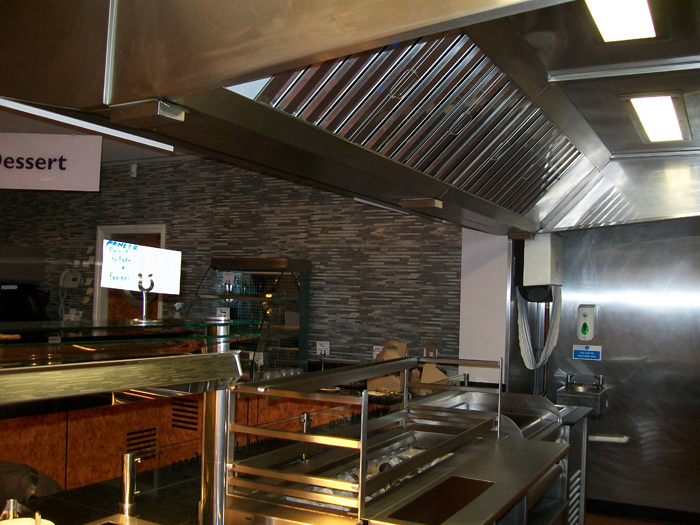
A canopy works with the plume: hot air and fumes rise from the cooking surface into the hood, and the extract fan removes them through filters and ductwork. Because the canopy is close to the source, it captures at relatively low airflow compared with trying to clear the whole kitchen. Grease filters sit in the canopy, so grease is captured early. See extraction canopies.
How a ventilated ceiling works
A ventilated ceiling draws air through slots or panels across a large area of the ceiling, often combined with fresh-air supply. It can give a clean, flat appearance, and can be used where headroom or appearance is a concern. The trade-offs are that capture happens further from the source, so airflow and design are more critical, grease filtration has to be designed in and cleaning access across a large ceiling area needs planning.
Which suits which kitchen
| Factor | Canopy | Ventilated ceiling |
|---|---|---|
| Capture close to source | Yes | Less direct |
| Typical use | Most commercial cooking lines | Specialist designs where appearance or layout demands |
| Grease filtration | In the canopy, easy to reach | Must be designed in |
| Cleaning | Filters and canopy accessible | Larger area to access |
| Design effort | Well established guidance | Needs specialist engineering |
For most commercial cooking, particularly heavy-duty frying, grilling and chargrilling, a canopy is the usual approach.
How to decide
Start from the cooking. If the kitchen does heavy frying, grilling or chargrilling, a canopy over the line is the established solution. If the design brief is driven by appearance, headroom or an unusual layout, ask a competent ventilation engineer to assess a ventilated ceiling, as HSE advises, and to show the calculations. Whichever you choose, insist that the design shows the extract rate, the make-up air, the filtration and how the system will be cleaned. Our kitchen extraction survey covers all four.
Whatever you choose, plan the make-up air
Both approaches remove air that has to be replaced, so make-up air is essential, as is balancing the extract against the supply. Read our guide to extraction rates and air changes and see how we design the whole kitchen extraction system.
Frequently asked questions
Can a ventilated ceiling replace a canopy over a grill?
HSE advises consulting a competent engineer where canopies are not used. Heavy-duty cooking is usually served by a canopy; we advise after a survey.
Is a ventilated ceiling more expensive?
It can be, because it needs specialist design. Cost depends on the kitchen; we quote after a survey.
Do ventilated ceilings need grease filters?
Grease filtration must be designed into the system, and the layout needs to allow cleaning.
Which is easier to clean?
Canopy filters and surfaces are generally easier to reach.