Why wok cooking is demanding
Wok ranges burn at very high output, and the food is cooked quickly over intense heat. The result is a strong thermal plume, a lot of steam and fine grease-laden vapour that rises fast. A canopy that copes with a standard cooking line can struggle over a wok range if it is too small, too high or starved of air.
Canopy size and position
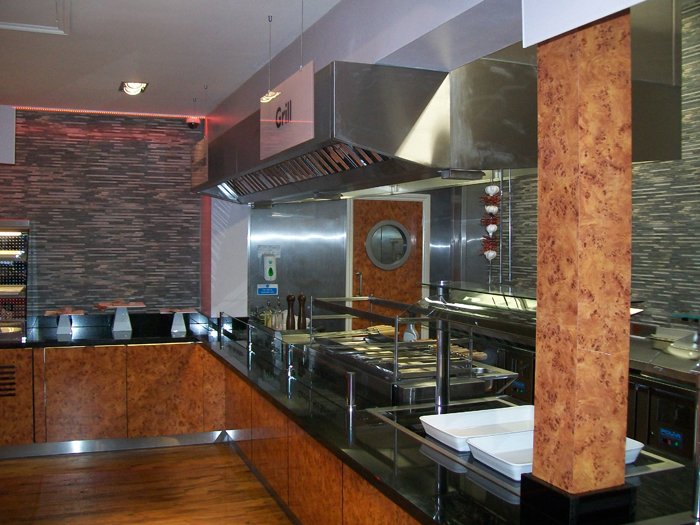
HSE guidance in CAIS10 says the canopy hood should be a suitable size, as close to the source as the work allows, with enough extraction to minimise fume spillage. For wok ranges that means the canopy must cover the full cooking footprint with generous capture at the front, where the cook works. Read our guide to canopy sizes and dimensions.
Make-up air and combustion
High-output gas burners consume a lot of air. HSE highlights that it is particularly important to ensure adequate make-up air for gas-fired appliances, because lack of it can lead to an accumulation of combustion products such as carbon monoxide. Wok kitchens commonly show the symptoms of poor make-up air first: smoky canopies, doors that pull shut and lazy flames. See make-up air systems.
Gas interlock
Where gas appliances rely on the extraction, an interlock should cut the gas if the extraction fails. In a wok kitchen with heavy extraction demand it is especially important that the interlock is commissioned correctly and tested regularly. See gas interlock systems and BS6173 explained.
Grease and cleaning
Wok cooking puts a lot of grease into the air. Filters need frequent cleaning, the ductwork needs access doors and a cleaning schedule, and the canopy and drip trays need regular attention. See baffle filters.
Questions to settle before you order
How many wok burners, and what is their gas rating? How wide is the cooking line, and where does the cook stand? How will make-up air reach the burners without blowing across the canopy? Where does the duct discharge, and what are the planning conditions on odour? How often will grease filters and ductwork be cleaned? Each answer changes the canopy, fan or air supply, so they belong in the design brief, not on site.
Takeaways and restaurants
Many wok kitchens are in takeaways and restaurants with homes nearby, so odour, noise and discharge height matter for planning. See takeaway extraction requirements and odour control.
Sources and further reading
Independent references we used, so you can check the rules yourself:
- HSE: Ventilation in catering kitchens (Catering Information Sheet 10)
- HSE: Gas safety in catering and hospitality (CAIS23)
- legislation.gov.uk: Gas Safety (Installation and Use) Regulations 1998
Frequently asked questions
Does a wok range need a bigger canopy?
It often needs a canopy sized for the intense plume and positioned close to the source. The designer decides from the equipment.
Why does my wok canopy smoke?
Common causes are an undersized or badly positioned canopy, blocked filters, a weak fan or missing make-up air.
Is a gas interlock required?
Where gas appliances rely on the extraction, an interlock is required; new installations and some modified ones must comply with BS 6173.
Can you design for takeaways and restaurants?
Yes, across the UK.