
Where carbon filtration fits
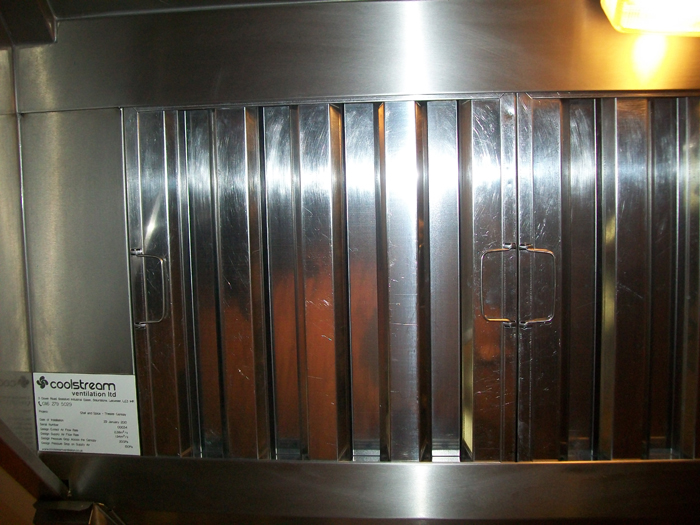
Odour control is a chain. The canopy captures the plume, baffle filters remove grease, any further filtration stages treat the air and a high-level discharge disperses what remains. Carbon filtration is an optional extra stage that adsorbs odour compounds. It does not replace good capture or grease filtration, and it will not work properly if grease reaches it.
What carbon filters do
Activated carbon has a huge surface area that traps odour molecules from the air passing through. Over time the carbon becomes saturated and stops working, so it has to be changed on a schedule. The air must be clean of grease first, or the carbon clogs and fails early.
Other filtration stages
| Stage | Role |
|---|---|
| Baffle filters | Remove grease droplets at the canopy |
| Finer grease and particle filtration | Capture smaller droplets where planning requires |
| Carbon filtration | Adsorbs odour compounds |
| High-level discharge | Disperses remaining odour |
Which stages you need depends on what you cook and what the planning authority requires; see kitchen odour control.
Space and airflow
Additional filters add resistance to the airflow and need space and access. The fan and ductwork must be designed for the extra resistance, or the extraction rate will fall. HSE advises that the airflow into the canopy should be uniform and constant (CAIS10), so the design has to be checked as a whole.
Maintenance
Saturated or blocked filters reduce performance and can raise resistance. Agree a replacement and inspection schedule, record it and include it in planned maintenance.
Questions to ask before adding odour filtration
What does the council require for this site? Which stages are proposed, and what is each for? What is the extra resistance, and can the existing fan cope? Where will the filters go, and can they be reached for replacement? How often must they be changed, and who will do it? Odour filtration that cannot be maintained will stop working, so plan the maintenance when you plan the equipment.
Costs and running considerations
Odour filtration adds equipment cost, resistance to airflow and a replacement-media cost over time. Weigh those against what the council requires and the risk of complaints. A well-designed scheme uses the minimum filtration that reliably meets the requirement and keeps it maintainable.
When to add odour filtration
Consider it where neighbours are close, planning conditions require it, complaints have been made or the discharge cannot be high enough. A survey will recommend the right combination for your kitchen. See how to remove cooking smells.
Sources and further reading
Independent references we used, so you can check the rules yourself:
- HSE: Ventilation in catering kitchens (Catering Information Sheet 10)
- Planning Portal
- legislation.gov.uk: Environmental Protection Act 1990 (statutory nuisance)
Frequently asked questions
How often do carbon filters need changing?
It depends on the filter, the cooking and the airflow. Follow the manufacturer's guidance and agree a schedule at design.
Can carbon filters replace baffle filters?
No. Grease must be removed first or the carbon will clog.
Will carbon filtration stop all smells?
It reduces odour but no system should be sold as eliminating all smell.
Can you retrofit odour filtration?
Often, if there is space and the fan can cope. We survey first.