Large kitchens, high stakes
Institutional kitchens may produce hundreds or thousands of meals on a fixed timetable, often with cooking, boiling, steaming, baking and dishwashing at scale. Downtime is costly and disruptive. Reliability, access for maintenance and robust documentation are as important as the initial design.
The core system
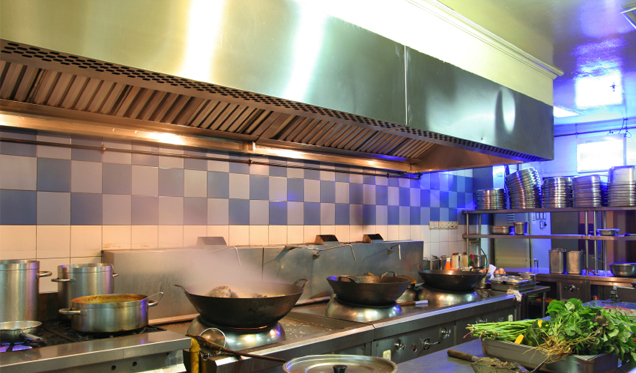
HSE's catering guidance (CAIS10) applies to catering kitchens generally: capture at source with a canopy for every appliance or source of fumes and heat, non-combustible canopies and ductwork with access for cleaning, fresh make-up air and a safe discharge. See kitchen extraction systems.
Steam, dishwashing and heat
Large kitchens generate a lot of steam and heat from boiling pans, ovens and dishwashers. Dishwasher canopies handle steam rather than grease. Balanced make-up air and, where needed, cooling keep staff comfortable; see extraction canopies and make-up air.
Working on live sites
Hospitals, schools and public buildings cannot stop. We plan work around operations, agree access, noise and dust control in advance and phase installations where necessary. See our public sector and education pages.
Noise, smells and neighbours
Kitchens on live campuses sit close to wards, classrooms and public areas. Fan noise and cooking smell need attention at design stage, with attenuation and sensible discharge positions; see reducing noise from kitchen extraction.
Questions to ask a contractor for a live site
How will work be phased around meals and operations? What access, noise and dust controls will be used? What is the programme, and what are the risks to it? How will the new system be commissioned and handed over without disruption? What records will you provide for audits? What maintenance is recommended, and how quickly is a fault attended? Good answers show experience of working where services cannot stop.
Compliance and audit readiness
Institutional kitchens are inspected and audited, so evidence matters. Keep design and commissioning records, maintenance logs, interlock test records and cleaning certificates together and up to date. We provide records at hand-over and can set up maintenance so that the paperwork is produced as part of each visit. Good records also make fault-finding quicker when something does go wrong. It is also sensible to agree in advance how the kitchen will be catered for if the extraction has to be shut down for repair, since a plan made calmly beats improvisation during service, and your catering manager, facilities team and contractor should all know who decides.
Maintenance and records
Planned maintenance, regular filter cleaning, ductwork cleaning to schedule, interlock tests and good records keep these kitchens reliable and audit-ready. See maintenance and servicing and our school and care home guide.
Sources and further reading
Independent references we used, so you can check the rules yourself:
- HSE: Ventilation in catering kitchens (Catering Information Sheet 10)
- legislation.gov.uk: Workplace (Health, Safety and Welfare) Regulations 1992
- HSE: Ventilation in the workplace
Frequently asked questions
Do hospital kitchens need special extraction?
The principles are the same as any commercial kitchen; scale, reliability and working around live sites differ.
Can you work in live hospitals or schools?
Yes. We plan around operations and agree access and controls in advance.
Do you maintain institutional kitchen plant?
Yes. We tailor planned maintenance to your equipment and budget.
Do you work for public sector clients?
Yes, directly and as a sub-contractor.