
Same system, different words
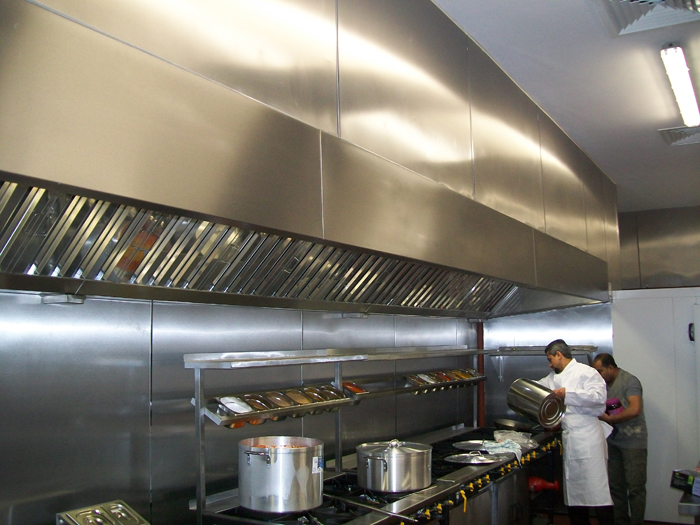
"Kitchen exhaust system", "kitchen extraction system", "kitchen ventilation system" and "extraction hood" or "canopy" are used almost interchangeably. In UK practice the usual terms are extraction (the system), canopy (the hood over the cooking line) and extract ductwork. All describe the same job: capturing and removing cooking fumes.
How a kitchen exhaust works
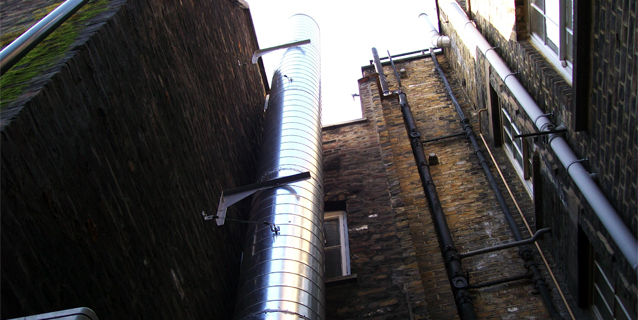
Fumes rise from the cooking surface into the canopy, pass through grease filters, travel through ductwork driven by a fan and are discharged outside. HSE's catering guidance CAIS10 describes mechanical extraction through a canopy over the cooking appliances as the usual way to remove fumes and vapour and discharge them to a safe location.
The parts
- Canopy (hood), see extraction canopies.
- Baffle filters, see baffle filters.
- Ductwork, see kitchen extract ductwork.
- Extract fan, see commercial extract fans.
- Make-up air, see make-up air systems.
- Gas interlock, see gas interlock systems.
Why a kitchen exhaust is not just a fan
Fitting a fan in a wall removes some air but does not capture the plume, filter grease or replace the air. Without a canopy, filters, ductwork, make-up air and controls, the system will not meet the ventilation or fire-safety requirements for a commercial kitchen.
UK rules
UK commercial kitchens must provide effective and suitable ventilation under the Workplace (Health, Safety and Welfare) Regulations 1992, and gas appliances bring the Gas Safety (Installation and Use) Regulations 1998. Standards such as DW/172 and BS 6173 describe good practice. See our regulations guide.
What to ask when specifying a kitchen exhaust
What airflow is the system designed for, and on what basis? Does it include make-up air? How is the grease filtered and the duct cleaned? Where is the discharge? Is gas interlocking included where needed? What records will I receive? The answers tell you whether you are being offered a fan or a designed, commissioned system.
Where to start
Start with a survey. Measure what is there, record the appliances and menu, check make-up air and the discharge and decide whether to repair, modify or replace. Our survey is free and without obligation, and we can supply scheme drawings so you can compare options.
Getting one designed
A kitchen exhaust system should be designed for your appliances, layout and building, then commissioned and documented. We survey, design, manufacture, install and maintain complete systems across the UK; see kitchen extraction systems.
Sources and further reading
Independent references we used, so you can check the rules yourself:
- HSE: Ventilation in catering kitchens (Catering Information Sheet 10)
- legislation.gov.uk: Workplace (Health, Safety and Welfare) Regulations 1992
- legislation.gov.uk: Gas Safety (Installation and Use) Regulations 1998
- BESA (Building Engineering Services Association)
Frequently asked questions
Is a kitchen exhaust the same as an extraction system?
Yes. UK practice usually says extraction, while exhaust is the term often used elsewhere.
Can I use a domestic cooker hood in a commercial kitchen?
No. Commercial cooking needs a commercial extraction system designed for the duty.
Does a kitchen exhaust need ductwork?
Yes. Fumes must be carried to a safe outside discharge.
Who designs a kitchen exhaust system?
A competent ventilation designer; we design, manufacture and install complete systems.